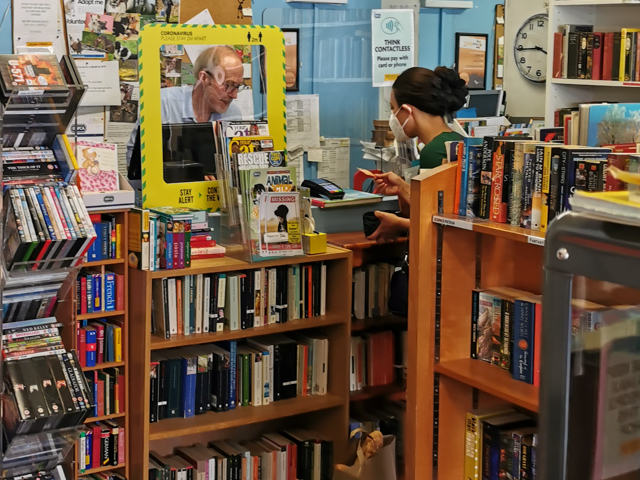
This is just a small selection of our stock. If you live in Cambridge, do drop in and browse. If you see a book you want in the online catalogue it may not yet be out on the shopfloor - please ask.
Location of Cambridge shop:
View Larger Map
RSPCA Cambridge and District branch covers an area of South Cambridgeshire stretching from Littleport in the North to Royston in the South and from Gamlingay in the West to Newmarket in the East. The branch is responsible for raising funds to run our animal welfare services within this area. We have three charity shops, one in Newmarket, at 156 on the High Street and two in Cambridge, at 188 and 184 Mill Road.
The Newmarket shop is located at 156 High street and needs your support as shoppers, donors and volunteers.
The RSPCA Cambridge secondhand and antiquarian bookshop is now open at 188 Mill Road, Cambridge; packed with lots of excellent books at reasonable prices. Our shelves are being updated daily with fresh stock as we bring out more of the thousands of books we've collected during the past year.
Our refurbished shop at 184 Mill Road has lots of bargains for the fashion-conscious. All our stock is carefully selected for quality, interest and value. Discards which are not quite up to our high standards will be sold at our monthly jumble sales.
Location of Newmarket shop
View Larger Map
At present we only have enough volunteers to open our smaller Cambridge shop on four mornings per week. Could you help? We are looking for motivated people with an interest in fashion who would be prepared to volunteer for one or more half days either weekly or fortnightly.
We also need people with an interest in books and/or music (or just willing to carry books up and down the stairs!) to help in the bookshop.
If you could help please email Ffiona RSPCA_Camshop@animail.net or phone 01223 212 644.
We will still be collecting donations of clothing, linens, china, etc. etc. Only the very best items will go out on sale at 184, but even worn or damaged textiles can be sold for recycling and raise valuable funds to support our work.
Our new house-clearance service continues to expand and we urgently need more volunteers who would be willing to help with this. Manual handling training will be given, but you don't need to be particularly strong as much of the work simply involves sorting and boxing items such as clothes, books and ornaments so that they can be transported to the shops. Anyone with use of a car to transport boxes would be particularly valuable. If you think you might be able to help, please phone 01223 212 644 and ask to speak to Fiona or Andrew.
Volunteering at one of our charity shops can involve much more than sitting behind a till - for example some volunteers help by doing online searches to find what prices we can charge for unusual items; adding descriptions of second-hand books to our online catalogue; and running stalls at local fêtes to get the maximum value from any books that didn't sell in the shop. You don't necessarily need to commit yourself to regular volunteering - there are also one-off tasks like house-clearance and donation collection where temporary extra hands are enormously helpful.
Volunteers sort, steam and price donated items - think of the bags of donated goods as a kind of gigantic lucky-dip from which we occasionally pull a vintage dress worth hundreds of pounds.
Our charity shops are at 188 Mill Road, Cambridge CB1 3LP (specialist second-hand bookshop); 184 Mill Road (clothing, music and bric-à-brac); and 156 High Street, Newmarket CB8 9AQ (general). Just drop in between 10 am and 4 pm Monday to Saturday, or phone 01223 212 644 (Cambridge Shops) or 07766 502 032 (Newmarket Shop).
Download an rspca shop volunteer form
Buy new books online via our webshop. We receive commission on every purchase.
Children's books about animals
Our volunteers will do house-clearances at no charge, subject to there being a reasonable proportion of saleable items in the contents removed. Unsaleable items will be disposed of via licensed contractors (usually the local authority trade waste for which we pay a fee). As we are responsible for the health and well-being of our volunteers we cannot take hazardous materials (e.g. asbestos sheeting), but we can remove and dispose of normal, non-hazardous rubbish (card, old newspapers etc.)
To discuss getting a house or flat cleared, please phone Fiona or Andrew on 01223 212 644
We need a minimum of 7 days notice to do a house clearance because it takes a while to notify the volunteers and fix a time when enough of them are available.
£3.50 would cover the cost of boarding a cat for a day
£4.00 would board a dog
£20 would pay for the cost of neutering a cat
£30 would buy another humane trap for catching feral cats so that they can be neutered
£95 would buy a microchip scanner
Textile crime, yes, really! If you are thinking of donating your unwanted or worn-out clothes, please do check that they are going to a genuine charity.
All RSPCA branches are separate charities affiliated to the national RSPCA. We are individually responsible for raising the money needed to run the local services which we provide.
Branch report and accounts (PDF) for 2007. This includes details showing how much money is raised at the three RSPCA Cambridge branch shops and how it is spent to help local animals. Note that the final amount on the balance sheet is the value of our animal clinic, if we closed it and sold the building; it does not represent cash in the bank.
We do not receive funding from the Government and it is comparatively rare for us to be given large donations or legacies, so we have to work hard to earn the money that is needed. Most of our funds are raised by a combination of charity shop sales, annual box collections, and a variety of stalls and events. All money raised locally is spent locally - our Headquarters, which runs the Inspectorate and National Control Centre, has its own funds.
Setting Up and Running Charity Shops: An Essential Guide (Paperback) by John Tough. Guide from the Association of Charity Shops on running a charity shop.
Running our animal welfare activities costs an average of £96,000 each year. This money is spent on keeping animals alive and relieving suffering by paying for veterinary treatments and on boarding unwanted animals until we can rehome them. In an average year we help around 3,000 individual animals. A very large proportion of our welfare work consists of providing low-cost veterinary care for animals whose owners cannot afford the full cost of treatment. There is no National Health Service for animals and without us most of them would either go without treatment or be put to sleep. It is often true that their owners ought to have been more responsible, but we have to deal with society as it is - and unfortunately we are all too often presented with a desperately ill animal and an owner with no money at all. The majority of the animals we take in for rehoming are not simply healthy unwanted animals but are either ill, injured or neglected so they usually require a considerable amount of expensive treatment before they can be rehoused.
Last updated 19/06/2008